Inspired by Jocko Willink’s ‘Extreme Ownership’: Leadership isn’t a rank, it’s a responsibility.
Why True Accountability Stays With You Long After You’ve Closed the Book
Some leadership books entertain. Some inform. Very few reprogram how you think when things go wrong.
Extreme Ownership by Jocko Willink and Leif Babin belongs firmly in the third category. I didn’t read this book as a theoretical exercise. I read it after years of leading engineering, data, and platform teams that were smart, well-funded, and staffed with people who genuinely wanted to do the right thing.
And yet, things still broke. Deadlines slipped. Priorities blurred. Trust eroded.
The uncomfortable realization the book forces on you is this:
Most leadership problems don’t start at the edges. They start at the center.
This blog goes deeper than a book summary. It connects the ideas from Extreme Ownership with real-world leadership scars across tech, scaleups, and large enterprises and with lessons echoed by leaders across history. I have also tried to put this in correlation with some of the industry leaders and organizations that went through changes over last many years.
1. Ownership Is Not About Blame – It’s About Control
When Johnson & Johnson faced the Tylenol crisis in 1982, or when Andy Grove’s Intel addressed the Pentium chip flaw, they didn’t just “take the blame.” They assumed absolute control over the system to fix the future.
One of the clearest corporate examples of ownership at scale was Johnson and Johnson during the Tylenol crisis in 1982. When cyanide-laced capsules led to customer deaths, the company did not deflect to distributors or regulators. Leadership pulled products nationwide, absorbed massive financial loss, and redesigned packaging standards for the entire industry. The decision was expensive in the short term, but it cemented long-term trust.
Another example comes from Intel under Andy Grove. When the Pentium chip flaw surfaced in the 1990s, the initial response was defensive. But Grove reversed course, publicly acknowledged the issue, and instituted a broad replacement program. The shift from defensiveness to ownership restored credibility and reinforced a culture of accountability.
These moments show that ownership is not about optics. It is about long-term control of reputation, culture, and direction.The most common misunderstanding of “Extreme Ownership” is that it’s about taking the fall. It’s not. Blame is emotional; ownership is operational.
The Operational Shift:
- Blame looks backward to find a culprit.
- Ownership looks forward to influence the system.
Ownership means:
- You assume control over outcomes
- You believe you can influence the system
- You act differently next time
In high-performing organizations I’ve seen, leaders who practice ownership do something subtle but powerful during failures: They remove names from the problem. They add structure to the solution. They keep emotion out of the diagnosis. This aligns strongly with research on learning organizations and psychological safety: teams improve faster when leaders model accountability without fear.
The moment a leader says, “This happened because I didn’t set this up correctly,” the room changes. People stop posturing. They start contributing. That’s not weakness. That’s authority.

2. “No Bad Teams, Only Bad Leaders”
Yes, that is the punch line. This line makes people defensive because it removes a convenient escape hatch. Yes, talent matters. Yes, constraints exist. But leadership quality compounds faster than individual brilliance.
When Satya Nadella took over Microsoft, the company was not short on talent. It was full of world-class engineers. What shifted was leadership behavior. Nadella changed the emotional climate from internal competition to a learning mindset. He clarified mission, reduced political friction, and modeled accountability at the top. Performance followed culture.
Across multiple organizations, I’ve seen the same team oscillate between high and low performance without any meaningful change in headcount. What changed was clarity of goals, consistency of decision-making, and leader behavior under pressure.
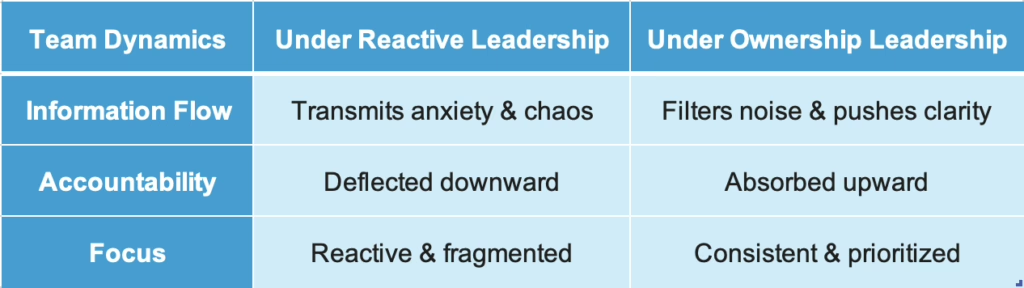
- When leaders shield teams from chaos, push clarity downward, and absorb accountability upward, teams stabilize.
- When leaders broadcast anxiety, change direction reactively, and publicly deflect responsibility, even great teams comes apart.
History reinforces this pattern across corporate turnarounds, military command, and sports dynasties. Leadership does not just set direction. It sets emotional temperature.
3. The Four Laws of Combat – What They Really Mean in Modern Organizations

3.1. Cover and Move: Incentives Beat Intentions
Amazon institutionalized this principle through its single-threaded leader model combined with shared metrics. While individual leaders own initiatives end-to-end, they are still measured against broader customer impact. That structure reduces local optimization and reinforces collective mission.
Silos don’t exist because people are selfish. They exist because:
- Metrics are misaligned
- Success is locally optimized
- Failure is individually punished
Cover and Move means leaders actively design shared success: Joint metrics. Shared accountability. Clear ownership boundaries. When teams succeed or fail together, behavior changes faster than any cultural memo ever will.
3.2. Simple: If You Need a Translator, You’ve Already Lost
Complexity often masquerades as sophistication. In reality, complexity is frequently unresolved thinking, a fear of being challenged, or a lack of conviction.
The strongest leaders I’ve worked with could explain:
- The strategy in two sentences
- The priority in one sentence
- The decision in one breath
Simplicity is not dumbing things down. It is distilling what matters. When leaders simplify, teams execute. When leaders complicate, teams hesitate.
3.3. Prioritize and Execute: Calm Is the Real Seniority Signal
In moments of crisis like incidents, outages, missed targets, teams look less at what leaders say and more at how they behave. Panic spreads faster than information.
Companies that attempted to protect every initiative during the financial crisis of 2008 often exhausted capital and collapsed under complexity. The focus required to prioritize like Netflix deciding to prioritize streaming over its legacy DVD business is what separates scaling companies from stagnant ones.
Leaders who win in chaos slow the room down. They:
- Identify the single most important constraint
- Communicate it clearly
- Execute it fully
Trying to solve everything simultaneously signals fear, not competence. Execution follows clarity, not urgency.
3.4. Decentralized Command: Context Is the New Control
Autonomous teams operate with clear mission context but significant local decision authority at Spotify through its squad model. That structure enables speed without central bottlenecks. Control does not scale. Context does.
Decentralized command only works when leaders:
- Clearly articulate intent
- Define boundaries
- Accept that some decisions will be imperfect
Micromanagement often reflects a leader’s discomfort with ambiguity, not a team’s inability. The best leaders I’ve seen spent far more time explaining why than dictating what.4. The Dichotomy: Where Most Leaders Fail Quietly
Leadership isn’t about picking a single trait; it’s about the constant calibration of opposing forces. You must be:
- Confident, but open (to being wrong).
- Decisive, but reflective (on the data).
- Demanding, but humane (to the person).
Mature leadership lives in the middle. Most leadership breakdowns happen when someone leans too far into one side: too aggressive becomes reckless; too empathetic becomes indecisive; too hands-off becomes absent. There is no arrival point only continuous awareness.
5. Discipline Equals Freedom: The “Mechanics” of Success
This isn’t a slogan; it’s a law of physics. In undisciplined systems, trust erodes because results are unpredictable. In disciplined systems like the operational rigors of Southwest Airlines or the executive reviews at Apple, freedom is the byproduct.
Discipline creates Trust → Trust creates Speed → Speed creates Optionality.
Final Thought
Extreme Ownership doesn’t make leadership easier; it makes it clearer. If something fails, the first question is no longer, “Who messed this up?” It is: “What did I not do to set this up for success?”
Once you internalize that question, there is no going back. Extreme Ownership isn’t a technique. it’s a lens through which you view every challenge you’ll ever face.
Disclaimer : This is the summary of the book with my experiences and industry learnings. The examples quoted are opinions.
Tags: ai, leadership, ownership, prioritize, strategy